
Many teams do not actually need a full automation system. They need something simpler: a place to keep repeatable text, quick notes, and workflow reminders beside the page where they are already working.
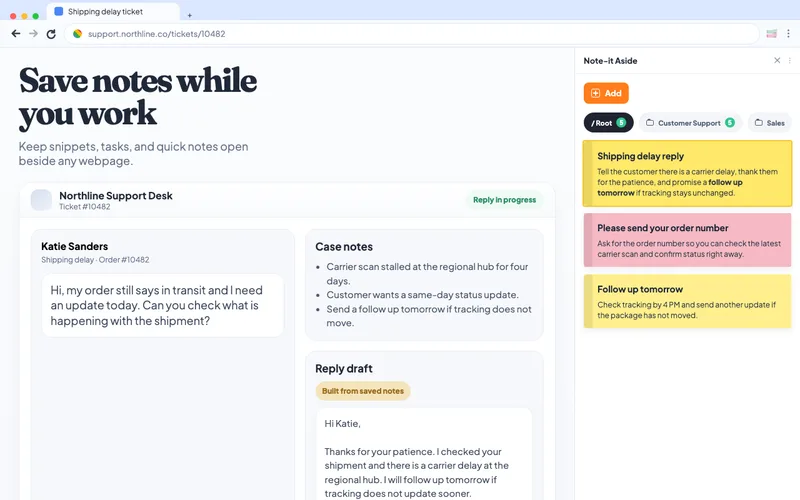
That is the gap where Note-it Aside fits.
When heavier text tools start to feel like too much
Tools such as Text Blaze can be powerful when your workflow depends on deep shortcuts, form logic, variables, and structured insertion rules. That power is real. It also comes with setup cost.
If your daily work looks more like these patterns, the overhead can start to feel unnecessary:
- you answer similar support questions across many tickets
- you keep follow-up notes while moving through a CRM
- you reuse store-operation replies for shipping, returns, and policy updates
- you want your saved text visible, not hidden behind memorized slash commands
In those workflows, the core problem is not automation depth. The core problem is access.
The browser-side difference
Note-it Aside stays open beside the current page. That changes the working rhythm in a useful way:
- your notes remain visible while you read and reply
- snippets can be grouped into folders by workflow
- quick task fragments can live beside reusable text
- sharing and backup exist, but they are not required to get started
This is a different posture from a text expander. It is not trying to automate everything. It is trying to reduce friction in the browser tab you already live in.
Where the lighter model works best
The lighter approach tends to fit teams that:
- work in browser-heavy tools all day
- want local-first behavior and no signup wall
- need quick reuse more than dynamic insertion logic
- prefer visible context over command-driven recall
For support and operations work, those tradeoffs are often positive. A visible side panel can be easier to teach and easier to adopt across a team than a more abstract shortcut system.
Where the heavier model still wins
If you need advanced insertion logic, fields, formula-style insertions, or deep expansion syntax, a heavier tool still has the advantage.
The point is not that one category replaces the other. The point is that the right tool depends on the actual job:
- choose automation depth when your workflow depends on it
- choose browser-side simplicity when visibility and speed matter more
A practical test
If your team keeps saying:
- “I just need the reply beside the ticket”
- “I do not want another tab open all day”
- “I need folders, not a scripting language”
then a lighter browser-side workflow is probably the better fit.
Note-it Aside vs Text Blaze
For teams evaluating a Text Blaze alternative, the decision is usually about how much automation they really need.
| Workflow need | Text Blaze-style tool | Note-it Aside |
|---|---|---|
| Advanced insertion logic | Stronger fit | Intentionally lighter |
| Visible snippets beside a CRM or support tool | Possible, but shortcut-led | Core workflow |
| Foldered notes and reusable replies | Requires setup discipline | Available immediately |
| Local-first, no-signup start | Not the main promise | Built for it |
Templates for this workflow
Pair the lighter setup with the sales template gallery, especially Proposal follow-up and Meeting request. A simple snippet can stay visible beside the CRM:
Thanks for reviewing the proposal. The most useful next step is a short confirmation call, and I can send the revised pricing summary right after.
Proof from the Chrome Web Store
“I do a LOT of copy/pasting and it is SO convenient to have all my notes right there. No switching tabs, or opening apps on another page.”
— Public Chrome Web Store review, English
Where to go next
For role-specific setup, start with the sales workflow page. If your snippets lean toward queues or store operations, compare the support snippet workflow and the e-commerce admin workflow.
Try it beside your next tab
Install Note-it Aside, open the side panel, and select the folder that matches this workflow.